
Why This Page Exists
Confidentiality and classification mean we can't show you our actual programme work. Thus to exhibit how we apply ourselves in a programme, we ran a self-contained demonstration programme — a fictional but realistic system, taken from concept through to a defined capability — using the same structure, rigour, and documentation approach we bring to client engagements.
This demonstration includes real issues from real programmes, recontextualised to anonymise original parties and fit the narrative of the demonstration.
What It’s About
A fixed-route autonomous shuttle service intended to operate a defined pilot corridor within an existing urban transport network. Chosen because it's a realistic, fundable first step for a typical operator introducing autonomy, and because it still requires every discipline we specialise in: safety-critical design, autonomous decision-making, and coordination across systems — many outside of our control.
What makes this a genuine system-of-systems problem is the boundary: the shuttle and associated aerial lift system, which must operate correctly alongside traffic signal infrastructure, emergency services, the existing public transit network, and passenger-facing information systems — none of which we control, and all of which have their own constraints, priorities, and failure modes.
Programme Preamble
The city has grown beyond the capacity its transport network was originally designed for. Congestion is now concentrated at a small number of critical nodes — the business district, the cultural and commercial centre, and several high-density residential areas — while building-height restrictions and ground-instability/seismic risk have pushed the wider city toward low-density sprawl, increasing the distances residents must travel to reach those nodes. Existing roads are too narrow to carry peak-period traffic, and at the key bottlenecks no additional surface area is available to widen them. Bus services were introduced to relieve pressure, but slower bus travel times measurably worsen general traffic during peak periods, and the road space committed to bus lanes is now considered better used for general traffic flow. Subway rail has been assessed as unviable for the area on first-pass review, and elevated road "fly-overs" are considered highly undesirable on planning and amenity grounds.
With ground-level widening, subway rail, and elevated roadways all ruled out, the city needs a transit mode that adds capacity along its own dedicated right-of-way — one that does not compete with existing road or bus infrastructure, does not require large-scale excavation, and does not visually dominate the skyline. Given the region's seismic and ground-stability context, any structural solution must also demonstrate credible earthquake resilience. This points toward an elevated, lightweight, autonomous transit system: one capable of connecting the city's congested nodes directly, operating largely independently of the existing road network, and imposing a materially smaller structural and visual footprint than a conventional elevated road or rail system.
A defined pilot corridor connecting one or more of the city's congested nodes, served by an autonomous transit system that measurably reduces peak-period road congestion — without requiring road-widening, large-scale excavation, or visually intrusive infrastructure. The system must be structurally credible under the region's seismic and ground conditions, operationally compatible with (rather than competing against) the existing transport network, and capable of extension to further corridors should the pilot prove successful.
NEXSystems Involvement
In this programme, NEXSystems is initially contracted for an Independent Systems Review of the bidding organisation’s proposed concept, prior to submitting it to the contracting authority (the local transit authority). Notes on the organisation’s progress:
The organisation has already concluded evaluation of the inputs and requirements issued by the contracting authority.
System Requirements have been identified and captured in a system specification, but have not yet undergone independent review.
No operational concept was issued or prepared, instead communications with the client have been noted and directly written into the system specification as requirements.
A high level architecture has been drafted.
Organisation’s supporting capabilities
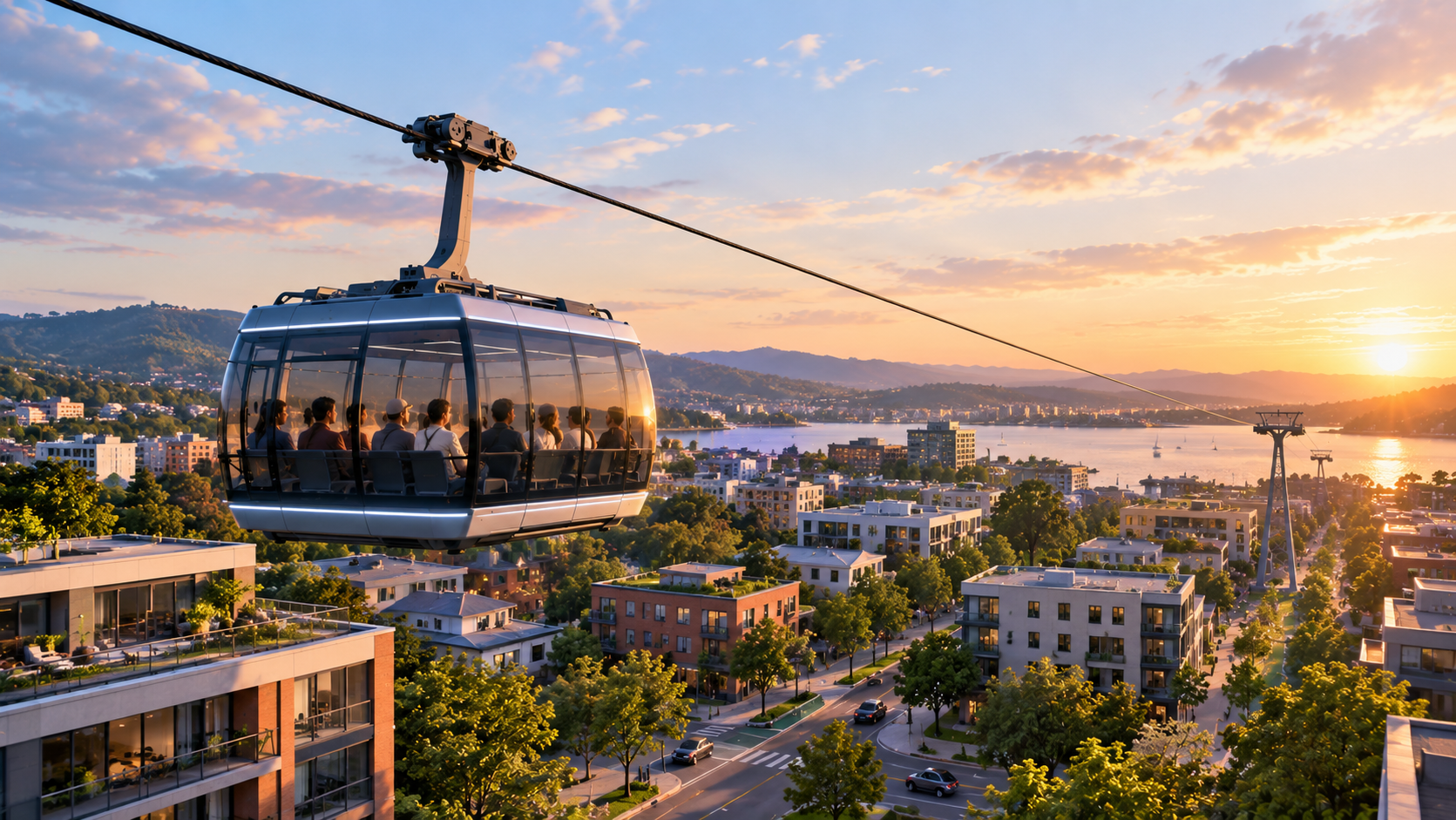
The concept is underpinned by the organisation’s existing experience and capabilities in cable-way transport systems, particularly within the recreation and tourism sectors. This experience provides a foundation for adapting the technology to the specific requirements of the application.
Concept highlights
Concept
Cabled, gondola-style system — leveraging a proven aerial-transport architecture.
Low surface footprint — minimising the infrastructure required at ground level.
Strong earthquake resilience — designed to offer favourable resilience in seismic environments.
Potentially lower installation cost than a conventional rail system — subject to detailed design and site-specific assessment.
Low visual impact — a less intrusive infrastructure profile that can better preserve the surrounding landscape and views.
Novel, client-specific gondola architecture — incorporating an innovative approach to right-of-way management and cable-way segmentation.
Key areas of uncertainty
What was discovered by the findings
Assessment
Independent System Review Summary
In this programme, NEXSystems is initially contracted for a ISR of the proposed concept.
The client (the executing company) has already started work, including evaluation of the User Requirement Statement issued by the end-user (the local government entity).
System Requirements have been identified and captured in a System Specification, but have not yet undergone independent review.
No CONOPS was prepared, instead communications with the client have been noted and directly written into the SS as requirements. [Risk of loss of context, as Requirements at this stage would already stand on interpretation].
Next actions
In this programme, NEXSystems is initially contracted for a ISR of the proposed concept.
The client (the executing company) has already started work, including evaluation of the User Requirement Statement issued by the end-user (the local government entity).
System Requirements have been identified and captured in a System Specification, but have not yet undergone independent review.
No CONOPS was prepared, instead communications with the client have been noted and directly written into the SS as requirements. [Risk of loss of context, as Requirements at this stage would already stand on interpretation].
Executive Summary
Bid Outcome
The city has grown beyond the capacity its transport network was originally designed for. Congestion is now concentrated at a small number of critical nodes — the business district, the cultural and commercial centre, and several high-density residential areas — while building-height restrictions and ground-instability/seismic risk have pushed the wider city toward low-density sprawl, increasing the distances residents must travel to reach those nodes. Existing roads are too narrow to carry peak-period traffic, and at the key bottlenecks no additional surface area is available to widen them. Bus services were introduced to relieve pressure, but slower bus travel times measurably worsen general traffic during peak periods, and the road space committed to bus lanes is now considered better used for general traffic flow. Subway rail has been assessed as unviable for the area on first-pass review, and elevated road "fly-overs" are considered highly undesirable on planning and amenity grounds.
Programme Status Metrics
Key Decisions/Actions/Activities
Text
NEXSystems Involvement
Prior to presenting the concept to the Authority, NEXSystems is contracted to assist with the corrections and final additions to the bid data-pack, and lead the technical delivery of the programme thereafter.
Organisation’s supporting capabilities
The concept is underpinned by the organisation’s existing experience and capabilities in cable-way transport systems, particularly within the recreation and tourism sectors. This experience provides a foundation for adapting the technology to the specific requirements of the application.
Concept highlights
Design
Cabled, gondola-style system — leveraging a proven aerial-transport architecture.
Low surface footprint — minimising the infrastructure required at ground level.
Strong earthquake resilience — designed to offer favourable resilience in seismic environments.
Potentially lower installation cost than a conventional rail system — subject to detailed design and site-specific assessment.
Low visual impact — a less intrusive infrastructure profile that can better preserve the surrounding landscape and views.
Novel, client-specific gondola architecture — incorporating an innovative approach to right-of-way management and cable-way segmentation.

Big Ideas, Real Impact.
Thoughtfully crafted to elevate what matters most.
With a vision for building something meaningful, our founder brings a blend of big-picture thinking and hands-on experience. They set the tone for everything we do.

Monet Goode
Focused, approachable, and driven by results, our sales manager is all about building strong relationships. They help connect people to the right solutions—with clarity and care.

Emmett Marsh

Creative and strategic in equal measure, our marketing director brings fresh ideas to every campaign. They turn insights into action and help our message resonate with the right audience.